Home / Blog / Dissecting kits and dissection boxes: a buyer's guide
Dissecting kits and dissection boxes: a buyer's guide
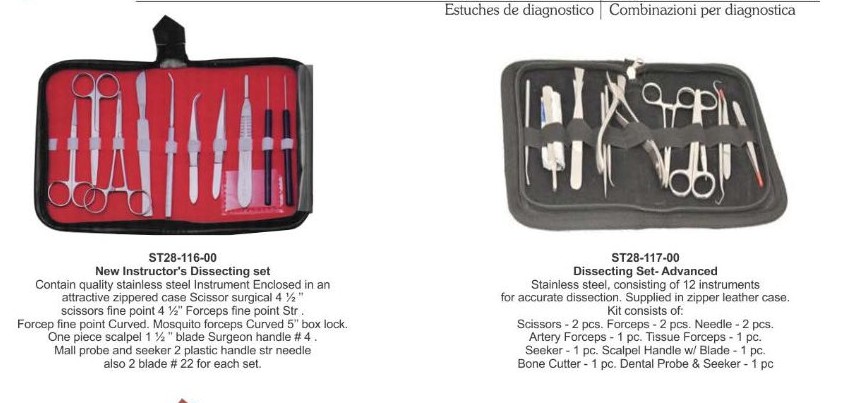
Dissecting kits (often called dissection boxes or dissection sets) are bought in large numbers by schools, colleges, universities, medical students and laboratory suppliers. They look similar in a catalogue, but the right kit depends on who will use it and how often.
1. Match the kit to the user
| User | Typical kit |
|---|---|
| School biology classes | Basic kits of around 6 instruments: scissors, forceps, a scalpel, dissecting needles and a probe, in a simple vinyl case. |
| College and university labs | Intermediate or advanced sets of about 12 instruments, with fine-point and curved patterns. |
| Medical and anatomy students | Advanced anatomy sets of up to 20 instruments in a zippered case, sometimes packaged with a stethoscope. |
| Research and specialist labs | Kits built to a specific instrument list, often with finer scissors and forceps. |
2. Check what is inside
A typical student kit includes dissecting scissors (sharp/sharp or sharp/blunt), dissecting forceps (fine point, straight and curved), a scalpel handle with blades, straight and bent dissecting needles, and a probe and seeker. Advanced kits add mosquito forceps, iris scissors, a ruler, a pipette, and more blades or spare parts. Always ask for the full contents list, with the length of each instrument.
3. Stainless steel or chrome-plated?
Stainless steel instruments resist corrosion and can be cleaned and reused for years, which suits universities and medical students. Chrome-plated instruments cost less and suit short-term or single-course use. Many suppliers stock both so they can offer schools a budget option.
4. Choose the case
Cases range from single-fold vinyl wallets and moulded plastic boxes to zippered leather or synthetic leather cases. The case affects both price and how professional the kit looks, which matters for retail and for medical students.
5. Bundles that sell
Popular bundles add a stethoscope (for first-year medical students), nitrile gloves and safety eyewear (for school labs), or invertebrate-specific instruments. Bundles raise the order value and make a kit easier to sell to institutions.
6. What to send in your enquiry
- Which user group the kit is for.
- The instrument list, or a catalogue reference for a standard kit.
- Stainless steel or chrome-plated.
- Case type and any branding on the case.
- Quantity and destination country.
See our dissecting kits and laboratory instruments, including student, advanced and anatomy sets.